

Peacemaker, p.1
Peacemaker!, page 1


The Home of Great Western Fiction
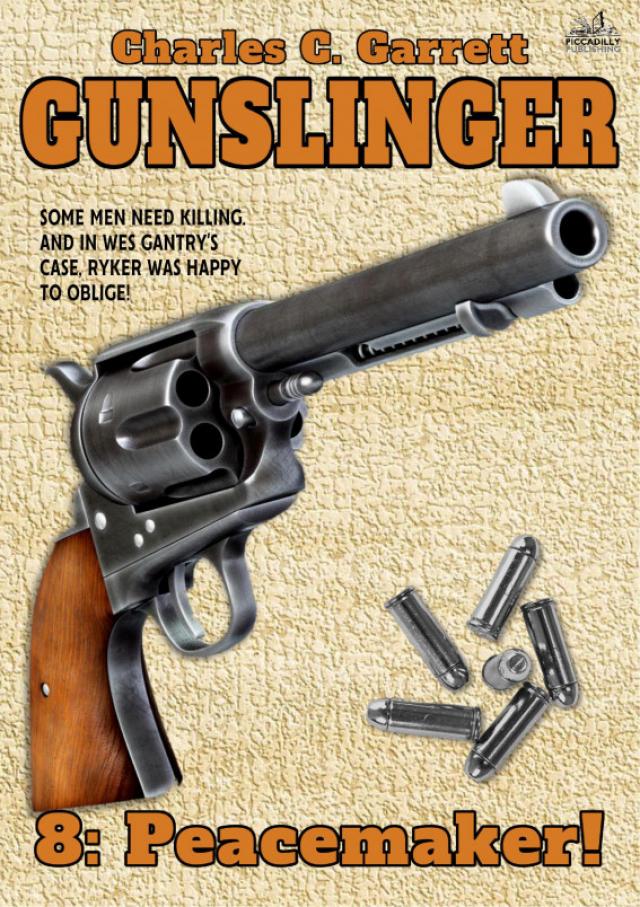
When it came to killing, nobody dealt out death like John Ryker. Onetime gunsmith, now turned deadly bounty hunter, his message was lethal—and he knew it. When Wes Gantry beat up Ryker’s woman, he made a big mistake. Ryker wanted blood and he’d stop at nothing to gun Gantry into the ground. And besides, his Colt forty-five Peacemaker—the bloodiest tool in the West—needed to see some action...
GUNSLINGER 8: PEACEMAKER
© Charles C. Garrett 1980
This electronic edition published May 2024
Names, characters and incidents in this book are fictional, and any resemblance to actual events, locales, organizations, or persons living or dead is purely coincidental.
You may not copy, store, distribute, transmit, reproduce or otherwise make available this publication (or any part of it) in any form, or by means (electronic, digital, optical, photocopying, recording or otherwise), without the prior written permission of the publisher. Any person who does any unauthorized act in relation to this publication may be liable to criminal prosecution and civil claims for damages.
This is a Piccadilly Publishing Book / Text © Piccadilly Publishing
Series editor: Mike Stotter
Visit www.piccadillypublishing.org to read more about our books
For a bounty hunter
of a different kind—
Derek Brown
Author’s Note
‘God did not make all men equal. Colonel Colt did.’
The exact source of that blasphemously accurate quotation is lost—perhaps in the blast of gunfire. But the sense of it remains.
Anyone with a modicum of knowledge of the Old West can rattle off a list of names that made history: Henry, Spencer, Sharps, Remington, Smith & Wesson, Winchester—Colt. Anyone who enjoys Western movies will quote Winchester and Colt as the guns those ‘high-riding heroes’ used. But most folks forget the vital relationship of gun and cartridge …
The Colt’s Dragoon or Navy models were fine weapons. Well-made, well-balanced; accurate and hard-hitting. The .44 caliber ball blown from the muzzle of a Dragoon, powered by upwards of fifty grains of black powder, would stop most anything on two feet. The .36 caliber of the Navy model was enough for most men, and the reduced weight of the smaller pistol allowed for easier—faster—handling. With the odd exception (e.g. The side-hammer Root) the Colt Company just didn’t know how to manufacture a bad gun.
But then the company created its masterpiece. In conjunction with the pistol-to-load equation ... The Colt .45 Peacemaker.
There had been experiments made with self-contained cartridges from around the 1840s on. There were the fulminate rim systems pioneered by S&W; lipfire cartridges; wafer primers; anything and everything to allow a shootist fast loading with maximum efficiency of fire power. The big disadvantage of the cap and ball pistols—no matter what their accuracy or muzzle velocity—was the simple fact of loading problems. Readymade cartridges were available, or could be made up by the user, but even those needed tamping down into the cylinder from the front. Then the firing nipples mounted around the rear of the cylinder needed capping. It was a lengthy process that all too often might result in a badly-capped nipple setting off a flash fire sequence that could explode the whole chamber in the shootist’s hand. With suitably horrifying results. The ideal of cartridge manufacturers was to produce a single shell containing the lead bullet, the explosive powder, and a firing cap. All in one neat package that could slip easily and swiftly into a revolver with a minimum of fuss and a minimum of danger to the user.
The result was the brass jacketed, center-fire cartridge that has been in use for the past ninety-odd years. At the business end there is a lead slug crimped into a metal jacket containing the powder; the tail flares slightly to hold a fulminate cap that explodes when struck sharply at the center of its firing point. The fulminate ignites on impact, thus detonating the enclosed powder load so that the slug has only one way to travel: forwards, down the barrel of the pistol.
The invention of such a cartridge heralded the end of the cap and ball weapons. The only problem remaining was to produce a gun that could utilize such shells with the same efficiency demonstrated by the inventors.
In 1873 the Colt factory found the answer in the Peacemaker.
And—as is so often the case of sheer genius—the answer was superbly simple. Colt produced a pistol based broadly on the established patterns of the Navy and Army models. It was six-chambered, the cylinder revolving about a central bolt, a lifting pin turning the cylinder after each shot. In place of the front-loading chamber bays of the earlier models, the factory introduced a rear-ward gate, covered by a sprung metal hinge that opened on the right side of the cylinder to allow access to the chambers, into which could be dropped the total load. In one clean movement the problems of tamping and greasing and capping were forgotten. To load the new gun all a shootist needed was to flick the loading gate clear and thumb the shells in. Then he was ready to fire.
The only problem remaining was the discharge of spent shells.
The old loads—either straight powder or ready-mades—got lost in the discharge. Thus the new Colts must find a way to expend the metallic cartridges, their jackets expanded by the explosion of powder within. Too often, in Western movies, the shootists merely lift their pistols and revolve the cylinders, the empty shells dropping like peanuts husks to the ground. It wasn’t like that. Couldn’t be: because a cartridge case, then, expanded when it was fired. It swelled up to fill the chamber. So Colt introduced the ejector rod—the small, secondary barrel that rests below and to the right of the main part. Mounted on a spring running the length of the tube, a stud designed to accommodate the tip of a man’s thumb drives a rod back into the cylinder, expelling the empty shell.
Working that ejector rod fast and slipping a fresh load into each chamber a practiced shootist could be firing while his cap-and-ball opponent was still seating caps on the nipples of his Colt’s Navy.
It was one huge advantage.
The other was the basic solidity of the Colt Peacemaker. The gun came in three sizes that tend to get lumped together under the general heading of ‘Peacemaker’. They were all the same pistol, with the barrel lengths marking one from another. The model I call the Peacemaker (and that is a personal definition that other gun folk might argue with) is the 4-inch barrel model. The 5-inch length is the Frontier Colt. The 7-inch barrel model favored by the Army is the Cavalry Colt. Forget the Buntline Special with its 18-inch barrel: at that length, you might as well use a rifle. And try drawing a ‘Buntline’ fast! You’ll be chewing bullets while the other man is still reloading.
The colt Single Action revolving pistol did two things for the Westerner anxious to stay alive in a hard, wild country.
It gave him a pistol he could rely on. He could load it quick and know that what he hit with one of those .45 caliber shells would probably be down and dying. It was also the toughest gun anyone had ever made: he could hammer nails with the butt and twist strands of barbed wire with the barrel. If it went wrong, he could buy another from any half way decent store—once the idea took off—and pick up shells from the same store.
It was a working gun. It stood up to rough treatment and went on firing. It shot true when it was looked after. It was a tool—a bloody tool, sure, but still just that—that made the Old West what it was.
It was the finest gun ever made.
Charles C. Garrett.
Phoenix, Arizona. 1979.
Chapter One
THE COTTONWOODS FLANKING the stream shone butter yellow in the late afternoon sun. Higher up the slopes the aspens had assumed the gleaming gold of newly-minted coins, the sunlight filtering down through the trees to dapple the trail with alternating patterns of light and shadow. In the canyons, the oaks and maples were ablaze with the burnished shades of autumn.
Fall colored the flanks of the Dragoon Mountains with vivid hues. But the beauty was lost on the tall man crouched beside the stream, his whole concentration focused on the tracks imprinted in the damp soil. Two horses had left spoor there, and two men had dismounted, kneeling beside their animals to drink from the crystal water.
The man stood up, stretching his shoulders so that the black jacket he wore was eased back across his broad chest, exposing a brocade vest across which hung the chain of a gold hunter watch. The silk patterning of the fancy vest and the dull gleam of the watch chain were the only points of color about him. His pants were the same dark hue as the jacket, matching the black boots and low-crowned black Stetson. He wore a white shirt, grubby now and opened at the collar so that the black string tie he wore hung down like ribbon on a hearse. His gun belt was black, a double loop Mexican rig tied down on his thigh with the darkly-grained butt of a Colt’s Navy model revolver protruding from the hand-tooled leather. As he rose, his right hand dropped instinctively to hover close to the gun while his left brushed absently over the neck of the big black stallion standing beside him.
The man alone provided a stark contrast with the richness of the fall colors, for his hair was as dark as his clothes and his handsome face was weathered by long hours of exposure to sun and wind and rain. But the contrast was further emphasized by the horse. A stallion, close on seventeen hands high, it was even darker than its owner, the glossy coat showing the first sign of the winter thickening of hair, so that the black saddle appeared dull in comparison. Two guns were scabbarded on the saddle: canted forwards on the right side was a massive Sharps .50 buffalo gun—the famous mile-sho oter favored by hide hunters and marksmen alike; on the left, the smaller stock of a Winchester ’73 carbine flanked the saddle flap.
The man was called John W. Ryker. He was a bounty hunter.
Once, he had been a gunsmith, but that was several years and many deaths agoi. Now—although he retained his deep interest in guns of every kind and had lost none of his skills—he used weapons to hunt men.
He corked the canteen he was filling and looped the carrying strap around the saddle horn. Then he swung astride the big horse and urged the beast across the stream.
‘Not long now.’ He said it softly, as though wary of disturbing the quiet air. ‘Be soon.’
The horse blew air through its nostrils and followed the gentle guidance of reins and heels through the water and up the far bank where the exit marks of two earlier travelers showed.
Ryker moved slowly, studying the ground until the watershed imparting dampness to the soil got deep enough that the tracks were lost. After that he looked at the drying grass and the branches leaning across the trail. The signs were small: a broken twig, its jagged edges not yet sealed by sap; a patch of grass crushed flat by a hoof; a scatter of leaves torn loose from the branch by a passing rider.
He smiled. It was a cold smile, expressing satisfaction rather than pleasure.
Night fell and he made camp under the lee of a ridge that hid his small fire from anything other than a direct approach up the scarp slope of the hill. He fed the horse and rubbed it down, then assembled his weapons on the canvas groundsheet spread over the grass and checked each one. He worked over the Colt’s Navy model first, checking the loads and cleaning the pistol with the array of equipment carried in his saddlebags and jacket. Then he checked the Sharps and the Winchester. Finally he reached under his jacket, drawing a .41 caliber Remington derringer—the tiny Over and Under model—from its specially-made holster at the small of his back. He drew a matched pistol from his right boot, discharged the four loads using the ejector rod he had designed himself to obviate the time-wasting process of poking the spent shells clear, and cleaned both pistols.
Only then, when all his guns were reloaded, did he set to preparing food.
Ryker was like that. To him, guns were a religion. Not only because they were the tools of his lethal trade—the marginal difference between life and death—but also because he loved them in a way only a fellow aficionado could appreciate. Once, back in Settlement, Arizona, when he was still running his gunsmithy, two cowhands had gotten into a quarrel over a girl. They had agreed to settle their differences at sundown, meeting on main street. One man had passed the afternoon in the saloon; the other had come to Ryker. Asked him to check over the Colt Dragoon he carried and make sure it was in perfect working order. Ryker had stripped the pistol down, repairing a slackened hammer spring and tightening the snatch lever on the cylinder. He had found the gun slightly unbalanced, and compensated the weight by soldering a little lead to the underside of the butt. That gun had fired straight while the other blew to the left. The cowhand who had used Ryker’s services put two .44 caliber balls through his rival’s chest while the other man was still trying to sight his pistol in. The incident had taught Ryker a lesson he never forgot: no matter how fast a man might draw, he was still only as good as the gun he used.
He woke before dawn, the internal clock that enabled him to govern his sleeping hours bringing him to full consciousness long before the sun lifted over the trees.
He stoked the embers of the fire into fresh life and brewed up some coffee. The false dawn lit the sky with a pale, bluish-grey light as he scooped beans and bacon from the pan. By the time true dawn lit the sky he was in the saddle and moving on down the trail.
Frost clouded the path, obscuring signs so that he was forced to rely on instinct and the lay of the land to guess his objective. It wasn’t that difficult, not now, because the trail led straight down the western edge of the Dragoons to the stage route linking Tombstone with Tucson. At the foot of the mountains there was a tiny settlement called Guapa, and he felt reasonably sure his quarry was headed there.
His quarry. Two men.
Human targets in the game of law and order. They had broken the law, therefore they were expendable. Worth money, even.
Billy Carter and Nathan Dixon had robbed a bank in Green Springs. Shooting the teller and the woman who screamed as they ran clear hadn’t hardly been worth the six hundred dollars they took out, but the bank figured it had a reputation to maintain so a reward of one hundred dollars a head was fixed. Plus ten per cent of whatever money the bounty man could bring back. Ryker had happened through Green Springs twelve hours after the raid and decided to hunt the robbers. He was headed for Tucson, anyway, so it seemed like a good idea.
He had trailed them over the crest of the Dragoons, pleased that the fall was closing in and sending the Apache groups south for the warmer climes of Mexico. Now, after a week of tracking, he was sure the two men were making for Guapa.
Why anyone would name a place that looked like a boil bulging from the butt end of nowhere with the Spanish for good-looking, Ryker couldn’t understand. The place was situated midway between the western edge of the Dragoons and the San Pedro river, stuck out on a flat plain that had nothing to show except cactus and ant hills. And the natural eyesores looked better than Guapa.
The stage office was the biggest building in town, and the only one that looked like anyone cared. It was a single-story, squat slab of adobe with a wooden verandah running round three sides and a pig pen attached to the corral at the back. A well provided water for both the station and the corral, and a ramshackle outhouse served as stabling for the replacement stage teams. Nailed to the front of the verandah was a crudely lettered sign, its red paint recently daubed afresh: Guapa Stage Ofisse. SaloonEets and good Lickor.
Beyond the way station there was a store with cracked windows and mounting piles of dead flies behind the yellowed glass; a dry goods emporium and the tumbled-in remnants of a livery stable. Three adobe shacks bulked out of the flatlands behind the misnamed town.
Ryker wondered why anyone would choose to live there.
He rode up to the stage office and dismounted.
Tethering the black stallion to the hitching rail, he slipped the safety thong free of the Colt’s hammer and stepped on to the porch. Bead curtains covered the doorway, rustling as he shouldered through.
Inside, the place smelled as bad as it looked. There was a mingled odor of rotgut whiskey and watery beer; the acrid smoke of cheap cheroots and sweaty shirts vying with the rancid stink of bad cooking. Two men looked up from a single bowl of chili, their mouths smeared with the peppery sauce.
‘Gents.’ Ryker touched his hat brim, heading for the bar, smiling at the man behind the counter and saying, ‘Whiskey. With a beer to chase it.’
The barkeep was fat and bald, with a florid face that looked like it might supply the grease for the pans Ryker could hear sizzling in the kitchen beyond. He nodded and set the drinks down. The bar was a single plank laid across a series of barrels: Ryker noticed that there was no place to hide a gun. He glanced idly along the wall behind and saw a rusty shotgun propped in an alcove. Too high to reach fast and too poorly cared for to be reliable.
He lifted his beer and turned to study the room.
The two men were ignoring him, concentrating on the chili. He looked at them from over the rim of the beer mug.
One was about his own height—topping six feet—with red hair and a bristling mustache. He wore a Rigdon & Ansley in .36 caliber holstered cross-draw on his left hip. A Bowie knife was sheathed on the right and a single-shot Spencer carbine was propped against his chair. The other one was shorter and younger, his face shaved cleaner than his dirty shirt. He carried two pistols: a Leech & Rigdon on his right hip and a Colt’s Paterson on the left. His hair was blond; curly and baby-soft.
They answered the descriptions given to Ryker back in Green Springs.
‘You want to eat?’ The barkeep was wiping a greasy plate in readiness. ‘Got chili all ready.’






